
Why So Many Staff Retreats Fall Flat (And How to Fix Them)
- Evenings and Weekends

- Jan 27
- 5 min read
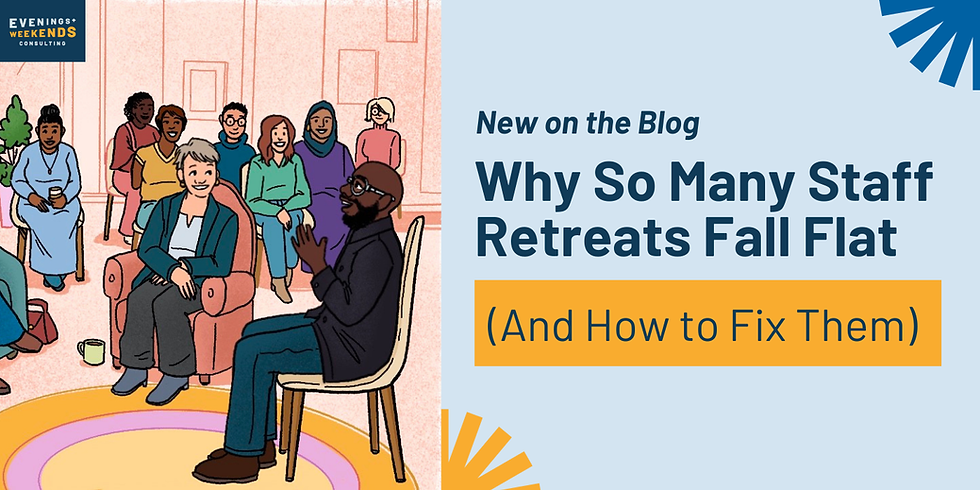
An eight-hour agenda. Cold coffee. Generic team-building exercises that make everyone cringe.
We've all been to bad staff retreats. The ones where we're stuck in front of a static PowerPoint presentation on a Saturday morning. Where we're forced to share a "fun fact" about ourselves in front of Board members we've never met. Or where we're asked to take part in “designing” a strategic plan where the outcome has clearly already been decided (without us).
But when retreats are done well, they can be transformative. A well-planned retreat can deepen relationships across teams, align participants on new strategies, and build the trust that's needed for difficult work ahead.
At Evenings & Weekends Consulting, we've had the privilege of creating gatherings that leave participants feeling energized, with a more expansive understanding of their work and shared vision. Here are a few tips from our team on how to do retreats right.
Know Exactly Why You're Gathering
As Priya Parker writes in The Art of Gathering, "a category is not a purpose."
Too often, we start by deciding the form of a retreat before its function. We book the community centre basement because it's where we always book. We choose the caterer that goes to the same dog park as our finance coordinator. We follow last year's agenda. And then we wonder why people leave uninspired.
Before planning any gathering, it’s important to ask yourself: Why are we doing this? Is there a strong purpose for us to be coming together?
If the answer is actually yes, let this goal drive every aspect of your decision making. For example, if you’re hoping to hammer out a 5-year operational plan, design your itinerary in a way that enables people to do their best thinking: with nourishing food, ample space for breaks, and during a work day that doesn’t coincide with their busiest time of year.
“What you're trying to achieve shouldn't be a laundry list of desired outcomes. Instead, focus on one big goal” — Laëtitia Eyssartel, Managing Director
Create a Values-Aligned Experience
If someone’s first experience of your organization was your retreat, what would they learn about your values?
The retreat should feel like an embodiment of your mission, not separate from it. For example, if you're an environmental nonprofit, why not skip the meeting room and opt for a guided walk in a ravine? If you're in the arts, begin or end with a collaborative visioning mural. If you work in food justice, try collaborative meal preparation as a team-building activity.
To deepen this work, hire and purchase from the communities you serve for your catering, facilitators, and supplies, and consider developing a list of values-aligned vendors who model decent work practices and share this resource across your network.
Centre Joy and Connection
The most memorable retreats include elements of pleasure and ease: good food, comfortable spaces, moments of laughter or reflection. These aren't frivolous additions to the "real work" of strategizing, rather, they’re the foundation that makes meaningful collaboration possible.
This means designing space for genuine connection, whether through collaborative activities or simply unstructured time to talk without an agenda hovering over every conversation. It also means intentionally breaking up silos: mixing people across departments or roles through icebreakers and activities so that fundraising staff connect with program teams, administrators learn about frontline challenges, and everyone gains a fuller picture of how their work fits together.
When people feel cared for and enjoy being together, they're more open to vulnerability, creativity, and the kind of honest dialogue that moves organizations forward.
If a big goal is team-building and relationship-building, it's helpful for a retreat to feel like a retreat—pleasurable, comfortable, a bit of a treat, with lots of space for folks to talk and connect. Programming should support those aims, not get in the way of them." — Daniel Sarah Karasik, Lead Strategist
"I attended a retreat that was focused on deepening relationships over food. It wasn't heavily programmed, families were invited to attend (and join in on specific activities/meals), but there was ample space to enjoy the weekend without feeling like it was a tonne of work on top of the regular work week. I loved it!" — Laëtitia Eyssartel, Managing Director
"When everyone is busy, or in a more reactive work flow, it can be easy to get disconnected from the 'why' of all that is keeping you busy. Taking time to recognize one another, and feel seen in your contributions, can be a meaningful way to feel more connected to the team and collective purpose. I’ve seen activities where people receive anonymous notes capturing what people appreciate/admire about one another make a deep impression. We don’t always take the time to give people their flowers and it makes a difference!" — Rudayna Bahubeshi, Principal Strategist
Design for Different Bodies and Minds
Inclusive retreat design requires thinking beyond physical barriers to the many different ways that people can experience spaces, groups, and information.
Physical accessibility: Look for gender-neutral bathrooms and changing rooms, and create options to stand, walk around, or move during sessions rather than sitting for hours.
Sensory considerations: Seek out low-light options for those sensitive to brightness, and provide information about scents and fragrances used in the space (Cleaning products, incense). Set up clearly designated quiet spaces with explicit norms (No talking? Or is quiet conversation okay?).
Social navigation: Not everyone processes in groups. Build in solo reflection time and offer multiple ways to participate.
Life considerations: Where possible, seek to offer flexible timing options (some people manage caregiving, health conditions, or have different energy patterns throughout the day). Consider childcare support or family-inclusive options for portions of the retreat.
"One big way to make sure you design a retreat that meets the needs of your team is to actually ask your team what they need - so pre-survey to understand what you need to work around is really key” — Laëtitia Eyssartel, Managing Director Many people appreciate knowing exactly what to expect, and what's expected of them. Send out pre-retreat communications that detail the agenda, the accessibility of the space, and if possible, the questions they'll be asked during the day. This helps people arrive mentally prepared and can reduce anxiety for those who process better with advance notice." — Kate Fane, Strategist
Meaningfully Involve People in Decisions
If your goal is to align folks around a new strategy or direction, this must be done with a true spirit of collaboration. Create structures that equalize participation (e.g., small group discussions where junior staff aren't overshadowed by senior leaders) and be transparent about how people's feedback will be considered and incorporated.
Just as importantly, be honest about what leadership can commit to afterward. Nothing deflates retreat energy faster than great ideas disappearing into a void. Plan your post-retreat communications: what was discussed, what you're implementing, and what you're not doing and why. What resources are available to support ideas that emerge? What happens if some folks can't attend—how will you keep them connected? How will you share what happened and what comes next?
"Give attendees a clear sense of whether they're the ones who set the strategy at the retreat (through some consensus or voting process) vs. whether they're surfacing thoughts, feelings, ideas, etc., to inform later (post-retreat) decision-making." — Daniel Sarah Karasik, Lead Strategist
"When it comes to strategizing about organizational goals or changes, I’ve heard from teams at a number of organizations that these rich and useful conversations could create confusion over time, because there was a lack of follow up or transparency on how the conversation would amount to any actions. Strategy sessions that don’t go anywhere can feel dispiriting if the energy and time devoted lacks output or influence on plans moving forward. Those next steps are critical" — Rudayna Bahubeshi, Principal Strategist
The Bottom Line
A retreat isn't successful because you had one. It's successful because people leave feeling more connected to each other and the work, with clarity about how their contributions during the retreat will shape what happens next.
Planning a retreat and not sure where to start, or worried about repeating past mistakes? We'd love to help. At E&W, we design and facilitate retreats that honor your mission, your people, and your goals. Get in touch to explore what's possible.


Comments